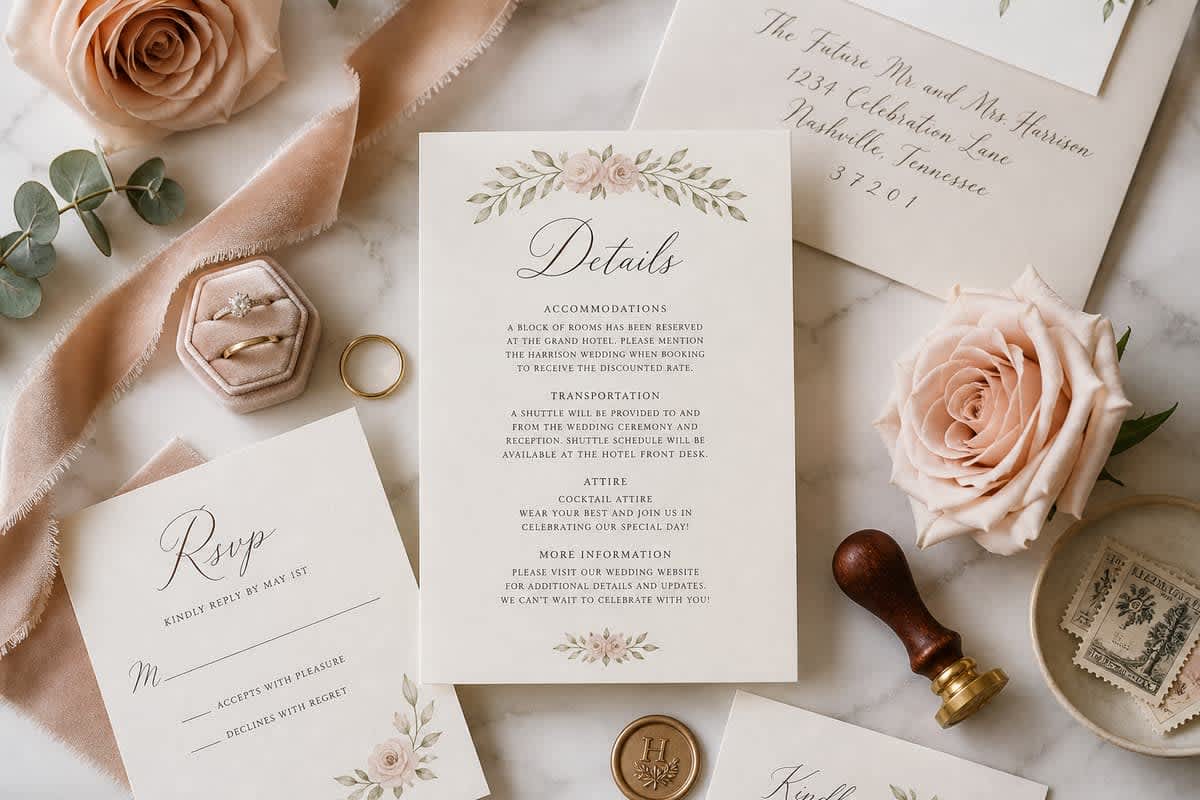
Wedding Details Card: Everything To Know
Wedding Details Card: Everything To Know
$0.50 – $2.00 per card (printed)
$0.10 – $0.50 per card (DIY)

What Is a Wedding Details Card?
A wedding details card is a small enclosure card included in your invitation suite that communicates supplementary information your guests need to know. It covers everything that doesn't fit on the main invitation, such as accommodation suggestions, dress code, transportation, registry information, and reception venue directions. Think of it as the practical companion to your beautifully designed invitation.
| Feature | Details |
|---|---|
| Also known as | Information card, enclosure card, insert card, details insert |
| Typical size | 3.5" x 5" or 4" x 6" |
| Placement in suite | Tucked behind the main invitation, in front of the RSVP card |
| Average cost (printed) | $0.50 to $2.00 per card |
| Average cost (DIY) | $0.10 to $0.50 per card |
While the main invitation announces your names, date, time, and ceremony location, the details card handles the logistics. It prevents your invitation from becoming cluttered with too much text, and it gives guests a quick-reference card they can keep handy as the wedding day approaches.
Not every couple needs a details card. If your wedding is a simple, local ceremony with the reception at the same venue, you may be able to skip it entirely. However, most couples find that at least a few extra details are worth communicating, making this card one of the most useful pieces of a wedding invitation suite.
What to Include on a Wedding Details Card
The best details cards are concise and only feature information your guests truly need. You don't have to include every item listed below. Choose the ones that are relevant to your celebration and leave out the rest.
| Information Type | When to Include It |
|---|---|
| Reception venue and directions | When the reception is at a different location from the ceremony |
| Accommodation and hotel blocks | When guests are traveling from out of town |
| Dress code or attire | When you have a specific theme, formal dress code, or outdoor setting |
| Transportation and parking | When parking is limited or shuttles are provided |
| RSVP instructions | When you are not including a separate RSVP card |
| Dietary requirements | When you need to collect allergy or meal preference information |
| Wedding website URL or QR code | Almost always recommended for linking to full details |
| Registry information | When culturally appropriate or when guests will expect guidance |
| Adults-only notice | When children are not invited |
| Post-wedding events | When you are hosting a welcome dinner, brunch, or after-party |
Let's explore each of these categories in more detail so you know exactly what to write.
Reception Venue and Directions
If your ceremony and reception are at different locations, clearly list the reception venue name, address, and start time. For venues that are difficult to find or do not appear accurately on GPS, consider adding brief written directions or a small map graphic.
Accommodation and Hotel Blocks
Guests traveling from out of town will appreciate knowing where to stay. Include the hotel name, a booking link or phone number, the group rate (if you have negotiated one), and the booking deadline. If you have reserved room blocks at multiple hotels, list at least two options at different price points.
Dress Code and Attire
Stating the dress code eliminates guesswork. Use clear labels such as "black tie," "cocktail attire," "garden party casual," or "smart casual." If your venue involves outdoor terrain, a helpful note like "the ceremony will be held on grass; flat shoes are recommended" goes a long way. For more guidance on what semi-formal wedding attire for men looks like, provide a reference link on your wedding website so guests can plan their outfits with confidence.
Transportation and Parking
Let guests know whether parking is available on-site, if there are nearby garages, or whether you are providing shuttle service between the hotel and venue. Include shuttle departure times if applicable.
RSVP Instructions
Many modern couples skip the traditional RSVP card altogether and instead collect responses through their wedding website. If you are going this route, the details card is the ideal place to explain how guests should RSVP, whether by visiting a URL, scanning a QR code, sending an email, or calling a phone number. Always include a response deadline.
Dietary Requirements
If your RSVP card does not already ask about dietary needs, add a line on the details card asking guests to inform you of any allergies or dietary restrictions. This helps your caterer plan effectively and ensures every guest is taken care of.
Wedding Website URL or QR Code
A wedding website can hold far more information than a single card. Including a URL or a QR code on your details card directs guests to a central hub where they can find maps, the full weekend schedule, registry links, FAQs, and more. This is one of the most universally useful items to include.
Registry and Gift Information
Etiquette around registry information varies by culture and region. In many cases, it is perfectly acceptable to include a subtle note directing guests to your wedding registry. If you prefer monetary gifts or charitable donations in lieu of physical presents, use gracious wording that makes it clear their presence is the most important gift.
Traditionally, registry details were only shared verbally or on a wedding website. Today, it is widely accepted to include a brief registry mention on the details card, especially when paired with a line like "Your presence is the greatest gift of all."
Adults-Only Notice
If your wedding is an adults-only celebration, the details card is the most tactful place to communicate this. Use polite, clear language so there is no ambiguity. A line such as "We respectfully request an adults-only evening" is direct without being dismissive.
Post-Wedding Events
Welcome dinners, day-after brunches, and farewell gatherings are common for destination or multi-day weddings. Provide the event name, date, time, location, and any notes about attire or cost so guests can plan accordingly.
Wording Tips for Your Details Card
The tone of your details card should match the rest of your invitation suite. A formal wedding calls for traditional phrasing, while a casual celebration allows for a more relaxed voice. Regardless of formality, clarity should always come first.
| Guideline | Explanation |
|---|---|
| Keep it brief | Use short sentences and bullet points rather than long paragraphs |
| Use headers or icons | Small section headers (e.g., "Accommodations," "Attire") make the card scannable |
| Match your tone | Formal invitations pair with formal language; casual invitations allow playful phrasing |
| Proofread everything | Double-check hotel names, URLs, dates, and phone numbers for accuracy |
| Avoid overcrowding | If you have more than five sections of information, direct guests to your website for the rest |
When communicating potentially sensitive information like an adults-only policy or a no-gifts request, choose phrasing that is warm and appreciative. Guests respond better to language that frames a request positively rather than as a restriction.
For registry wording, avoid sounding transactional. Instead of "We are registered at Store X," try "For those who have asked, we are registered at Store X." This subtle shift acknowledges that the mention is in response to anticipated questions, not a solicitation.
Wedding Details Card Examples
Seeing how other couples format their cards can help you decide what to include on your own. Below are three common styles with sample content to spark inspiration.
| Style | Best For | Typical Sections Included |
|---|---|---|
| Minimalist | Local weddings with one venue | Wedding website URL, dress code |
| Standard | Weddings with out-of-town guests | Accommodations, transportation, website, attire, RSVP instructions |
| Comprehensive | Destination or multi-day weddings | Accommodations, directions, shuttle schedule, weekend events, registry, dietary requests, website |
Minimalist Example
A minimalist details card might read:
"Cocktail attire requested. For more information and to RSVP, please visit ourweddingwebsite.com."
This two-line approach works beautifully when most of your guests are local and the ceremony and reception are at the same venue.
Standard Example
A standard card might be organized with small headings:
Attire: Semi-formal
Accommodations: A room block has been reserved at The Grand Hotel. Book by September 1 using code SMITH2025.
Shuttle: Complimentary transportation will depart from the hotel lobby at 4:00 PM.
RSVP: Please respond by August 15 at ourweddingwebsite.com
Comprehensive Destination Example
For a destination wedding, you might include sections covering travel tips, recommended airports, resort booking information, a full weekend itinerary, local activity suggestions, and a QR code linking to your website. Because this amount of information can overwhelm a single card, many couples use a slightly larger card size (5" x 7") or include two insert cards.
Do You Need a Details Card if You Have a Wedding Website?
Yes, in most cases a details card is still worth including, even if you have a comprehensive wedding website. Not all guests will visit the website before the event, and a physical card serves as a tangible reminder of key logistics.
| Comparison | Details Card | Wedding Website |
|---|---|---|
| Format | Physical, included in the invitation suite | Digital, accessible via URL or QR code |
| Information capacity | Limited (5 to 7 key points) | Unlimited |
| Audience | All guests, including those less comfortable with technology | Guests who are online and check links |
| Updatable | No; once printed it cannot be changed | Yes, can be updated anytime |
| Cost | $0.10 to $2.00 per card | Free to $35 per month depending on the platform |
The smartest approach is to use both. Place the most essential, time-sensitive information on the printed details card, and direct guests to the website for expanded content. This strategy ensures that every guest, regardless of tech comfort level, has the information they need.
Include a QR code on your details card that links directly to your wedding website. This bridges the gap between print and digital, making it effortless for guests to access additional information with a quick scan from their phone.
Design Tips for a Polished Details Card
Your details card should look like it belongs in your invitation suite. Consistent design creates a cohesive first impression and reinforces your wedding's visual theme.
| Design Element | Recommendation |
|---|---|
| Card stock | Match the weight and texture of your main invitation |
| Typography | Use the same font family or a complementary one |
| Color palette | Stay within your wedding color scheme |
| Layout | Use clear section headings, icons, or divider lines for readability |
| Size | Slightly smaller than the main invitation (3.5" x 5" or 4" x 6" are standard) |
| Margins | Leave adequate white space to avoid a cramped appearance |
Icons are a popular design choice for details cards. A small bed icon next to accommodation info, a car icon next to parking details, and a fork-and-knife icon next to dietary notes help guests scan the card quickly and find what they need.
If your invitation features a border, motif, or monogram, carry that element onto the details card in a subtle way. A matching border along the edges or a small monogram at the top ties the pieces together without making the card feel overly decorated.
How to DIY Your Wedding Details Card
Creating your own details cards is one of the easiest wedding stationery projects to tackle at home. With the right tools and templates, you can produce professional-looking cards for a fraction of the cost of wedding invitations.
| DIY Method | Skill Level | Estimated Cost per Card |
|---|---|---|
| Canva or similar free design tool | Beginner | $0.10 to $0.30 |
| Adobe Illustrator or InDesign | Intermediate to advanced | $0.10 to $0.25 |
| Downloadable template from Etsy | Beginner | $0.15 to $0.50 (includes template purchase) |
| Online print-on-demand service | Beginner | $0.50 to $1.50 |
Step-by-Step Process
- Choose your card size. Measure your invitation and select a details card size that fits neatly inside the same envelope. Standard sizes are 3.5" x 5" and 4" x 6".
- Select a design tool. Free platforms like Canva offer wedding-specific templates you can customize with your own colors, fonts, and text.
- Write your content first. Draft all the information you want to include before designing. This prevents layout headaches later.
- Design the card. Place your content using clear headings and consistent spacing. Keep fonts readable at the printed size.
- Print a test copy. Print one card at home to check for typos, alignment, and color accuracy before committing to a full run.
- Print the final batch. Use a home printer with quality card stock, or upload your design to an online printing service for a more polished finish.
- Trim if needed. If printing on full sheets, use a paper trimmer for clean, straight edges.
Always print a test card before placing a large order. Colors can look different on screen than on paper, and a single typo in a hotel name or website URL can cause confusion for every guest on your list.
Details Card Etiquette
Even a small card carries etiquette considerations. Following a few guidelines ensures your details card is helpful, polished, and respectful of your guests.
| Etiquette Topic | Best Practice |
|---|---|
| Registry mentions | Keep the wording gracious; never make it sound like gifts are expected |
| Adults-only wording | Use warm, respectful phrasing and address invitations only to the invited guests by name |
| No-gifts requests | Frame as a positive ("Your presence is our greatest gift") rather than a prohibition |
| Sending timeline | Mail your invitation suite (including the details card) six to eight weeks before the wedding |
| Information accuracy | Verify every URL, phone number, address, and date before printing |
One common question is whether it is acceptable to request no gifts. While the sentiment is well-intentioned, a blunt "no gifts" statement can make some guests uncomfortable. A softer approach is to say something like "Your love and presence are all we wish for." If you prefer charitable donations, suggest a cause and include details on how to contribute.
When addressing an adults-only wedding, the most gracious method combines card wording with envelope addressing. Address invitations only to the adults by name (without "and family"), and include a gentle note on the details card. This two-pronged approach minimizes misunderstandings.
Frequently Asked Questions
What is the difference between a details card and an RSVP card?
An RSVP card is specifically for collecting guest responses: whether they will attend, how many are coming, and sometimes meal preferences. A details card, on the other hand, provides logistical information like venue directions, hotel suggestions, dress code, and website links. They serve different purposes and are often both included in an invitation suite.
What size should a wedding details card be?
The most common sizes are 3.5" x 5" and 4" x 6". The card should be slightly smaller than your main invitation so it layers neatly inside the envelope. For destination weddings with extensive information, a 5" x 7" card or even a folded card may be more appropriate.
How many details cards should I order?
Order one details card per invitation, not per guest. Since invitations are typically sent per household, the number of details cards should match your invitation count. Add an extra 10% to 15% for mistakes, last-minute additions, and keepsakes.
Can I skip the details card entirely?
You can, especially if you have a wedding website that covers all the logistics and your guest list is comfortable navigating online. However, a physical card ensures that older guests or those who do not check websites regularly still receive essential information.
Can I include more than one details card?
Yes. Some couples include two insert cards: one for general details and one specifically for accommodation or travel information. Just be mindful of envelope weight and postage costs, as additional cards may push your suite into a higher postage bracket.
When should I send my invitation suite with the details card?
For local weddings, mail invitations six to eight weeks before the wedding date. For destination weddings, send them eight to twelve weeks in advance to give guests enough time to arrange travel and accommodations. For a complete timeline of when to handle each planning task, consult a wedding planning checklist to stay on track.